SDXTDD-2W Ad-Hoc Wireless Broadband Module
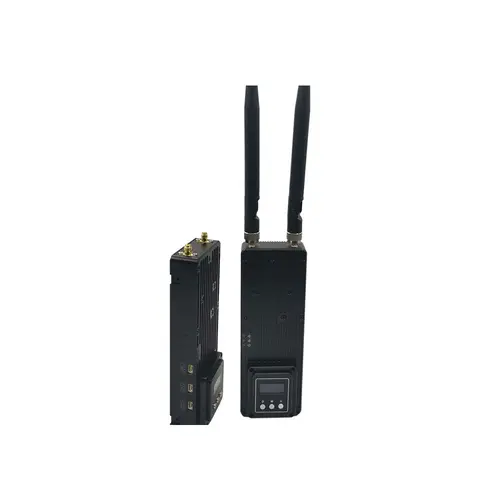
SDXTDD-2W
Higher-power TDD-COFDM ad-hoc data link with 2W output, ≤30ms latency, and 30Mbps throughput for industrial robots and extended-range drone operations.
Technical Specifications
| 800 MHz / 1.4 GHz / 2.4 GHz selectable | |
|---|---|
| TDD-COFDM MIMO | 2W · 30 Mbps |
| ≤30 ms end-to-end | AES256 |
| NLOS 500–1500 m | LOS 5–18 km |
| CAN, RS-232, TTL | DC 9–16V |
Dimensions: 166 × 58 × 34 mm
Overview
The SDXTDD-2W Ad-Hoc Wireless Broadband Transmission Module extends the SDXTDD platform with higher transmit power -- 2W -- for operators who need greater range without stepping up to a rack-mount chassis. It maintains the same TDD-COFDM core, OFDMA modulation, and MIMO multiplexing as the standard SDXTDD, achieving non-line-of-sight (NLOS) coverage of 500-1500 meters and ground line-of-sight (LOS) distances of 5-18 kilometers. End-to-end latency remains under 30 milliseconds, and the module delivers a clean 30 Mbps IP channel with full-duplex transparency.
The SDXTDD-2W integrates an innovative LCD panel for on-device configuration and a rich set of data interfaces -- CAN bus, RS-232, and TTL level -- making it a self-contained broadband radio that connects directly to industrial equipment without external interface boards. Pure hardware connection means plug-and-play deployment in minutes.
Key Features
- 2W transmit power (33 dBm) for extended range at NLOS 500-1500m and LOS 5-18km
- 30 Mbps IP throughput with full-duplex transparent channel via dual locking RJ45 Ethernet ports plus a third internal port
- Sub-30 ms end-to-end latency supporting real-time remote control and teleoperation
- Multi-mode networking supporting point-to-point, point-to-multipoint (16 max), mesh, and relay topologies on a single frequency
- Integrated LCD panel for on-site parameter configuration without a computer
- AES256 encryption settable via the LCD interface
- Dual-antenna 1T2R MIMO diversity for robust link performance
- Wide voltage input from 9 to 36V DC with 18W typical power consumption
- Compact industrial form factor at 166x58x34mm and 320g, easy to integrate into enclosures or equipment racks
- Selectable frequency bands at 800 MHz, 1.4 GHz, and 2.4 GHz with bandwidth from 1.4 to 20 MHz
Technical Highlights
The SDXTDD-2W leverages time-division duplex (TDD) over COFDM, where uplink and downlink share the same frequency channel in alternating time slots. This architecture halves spectrum requirements compared to frequency-division systems and makes international frequency coordination simpler. OFDMA divides the channel into orthogonal subcarrier groups, each assigned to a different user or traffic flow, enabling multiple simultaneous connections within the same channel bandwidth. MIMO 1T2R receive diversity significantly improves fade margin, especially in multipath-rich industrial environments. The adaptive modulation scheme (BPSK through 64QAM) and selectable bandwidth (1.4 to 20 MHz) let the operator trade range for throughput in real time via the LCD panel.
Applications
With its 2W output and industrial I/O, the SDXTDD-2W is designed for medium-range robotics, drone command-and-control, and industrial automation links. It serves as the wireless backbone for patrol robots, bomb disposal units, firefighting robots, unmanned ground and aerial vehicles, and unmanned surface vessels. The module is equally deployed in public safety communications for police, fire rescue, emergency response, maritime law enforcement, customs, border security, and forest fire prevention. The CAN bus interface makes it particularly well-suited to robotic platforms that already use CAN for actuator and sensor communication.
Why Choose This Module
The SDXTDD-2W offers the sweet spot between compact integration and real-world reach. Its 2W amplifier delivers reliable broadband over kilometers of challenging terrain while still fitting in a module that weighs 320 grams and draws only 18W. The LCD panel eliminates the need for a configuration laptop in the field, and the native CAN/RS-232/TTL interfaces wrap serial control buses directly into the wireless link. For integrators who need more power than a micro module but less bulk than a rack system, the SDXTDD-2W is the right fit.
Related Products
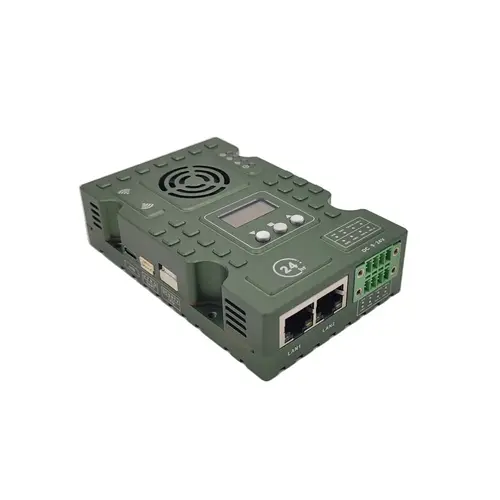
Fengjin FHSS Broadband Transmission System
Industrial FHSS frequency-hopping broadband data link with 130MHz hopping bandwidth, AES256, MIMO, and mesh networking for interference-resistant NLOS/LOS operation.
- 1.400–1.530 GHz · 130 MHz hopping BW
- 300 mW · BPSK/QPSK/16QAM/64QAM
- 30 Mbps · 50 ms latency · AES256
- Mesh, relay, PtP, PtMP (16 nodes)
- RJ45, CAN, RS-485, TTL interfaces
- 110.5 × 70 × 28.5 mm · 236 g
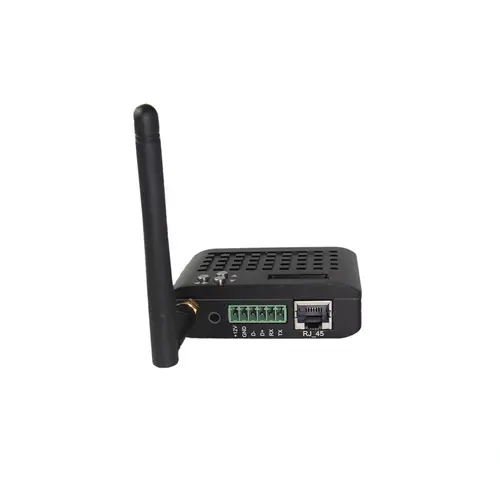
HBCOFDM Micro Broadband Transceiver
Ultra-compact TDD-COFDM bidirectional data/video transceiver with 10–30ms latency and 2.4GHz ISM band, purpose-built for UAV, drone, and short-range robotic links.
- 2405–2479 MHz ISM · TDD-COFDM
- 100 mW–1W · 1–10 Mbps throughput
- 10–30 ms latency · AES128 encryption
- Air-to-ground 5–20 km · Ground LOS 1–5 km
- RJ45, RS-232/422/485 · 110 g
- 67 × 51 × 22 mm · 110 g
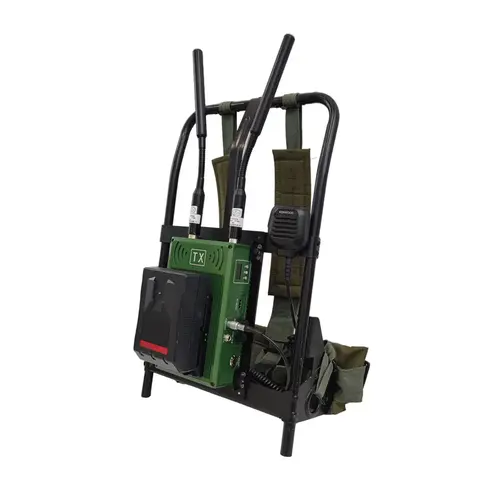
SDX-1080DTA Backpack Duplex Voice HD Video System
Military backpack COFDM HD video system with duplex voice intercom, 60ms low latency, AES256 encryption, and SDI/HDMI inputs for tactical field video relay.
- 300–4400 MHz · COFDM · 2W output
- H.264 · 1080P · 60 ms · AES256
- Duplex digital voice intercom
- SDI + HDMI dual input
- Military backpack design · TF card slot
- TX 204 × 125 × 55 mm · RX 1U 480 × 280 × 45 mm
Interested in This Product?
Contact us for pricing, custom configurations, and technical support for the SDXTDD-2W Ad-Hoc Wireless Broadband Module.
Get a Quote