The Wireless Transmission Landscape
Wireless transmission technologies are increasingly central to modern life, from smartphones and smart homes to medical devices and industrial automation. Each technology occupies a specific niche defined by range, data rate, power consumption, and application domain. Understanding how these technologies compare helps in selecting the right solution for mission-critical applications.
Bluetooth: Short-Range Low-Power Connectivity
Bluetooth technology is one of the most familiar wireless transmission methods. Operating over short distances (typically up to 10 meters), Bluetooth enables device-to-device data transfer with low power consumption and low cost. It powers wireless headphones, smartwatches, fitness trackers, and countless consumer electronics. Bluetooth Low Energy (BLE) extends battery life further, making it suitable for IoT sensors and wearable devices. However, Bluetooth’s limited range and bandwidth make it unsuitable for video transmission or long-distance applications.
Wi-Fi: High-Bandwidth Local Area Networking
Wi-Fi has become the dominant wireless transmission technology for local area networking in homes, offices, and public spaces. With the adoption of Wi-Fi 6 and Wi-Fi 6E, theoretical peak speeds reach 9.6 Gbps, supporting high-definition video streaming, large file transfers, and dense device environments. Despite its throughput advantages, Wi-Fi has inherent limitations: relatively short range (tens of meters), susceptibility to interference in crowded spectrum bands, and higher power consumption compared to Bluetooth or ZigBee.
NFC, ZigBee, and Satellite Communication
Near Field Communication (NFC) enables quick, close-proximity data exchange for contactless payments, access control, and data pairing. Its range is measured in centimeters, making it ideal for secure transactions but not for data transmission over distance.
ZigBee is purpose-built for low-power mesh networking in smart homes and industrial automation. Its self-organizing network topology allows dozens or hundreds of devices — smart lights, sensors, switches — to communicate reliably with minimal power draw. ZigBee excels where low data rates and long battery life matter more than bandwidth.
For truly long-range wireless transmission, satellite communication remains the only option with global coverage. It is indispensable for maritime, aviation, remote exploration, and broadcast distribution, though high latency and cost constrain its use for real-time interactive applications.
5G: The Next Generation of Cellular Wireless Transmission
The rollout of 5G technology represents a paradigm shift in wireless transmission, offering high data rates (multi-gigabit), ultra-low latency (as low as 1 ms), and massive device density. These capabilities unlock new applications in augmented reality, autonomous vehicles, remote surgery, and smart city infrastructure. While 5G covers wide areas with high throughput, its reliance on dense base station infrastructure means coverage gaps remain in rural and remote regions.
Where COFDM Fits: Professional-Grade Wireless Video and Data
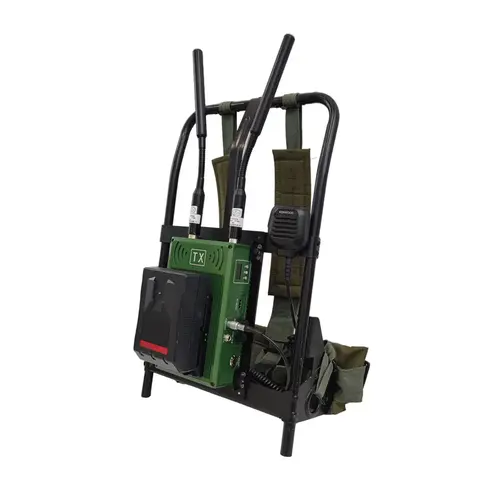
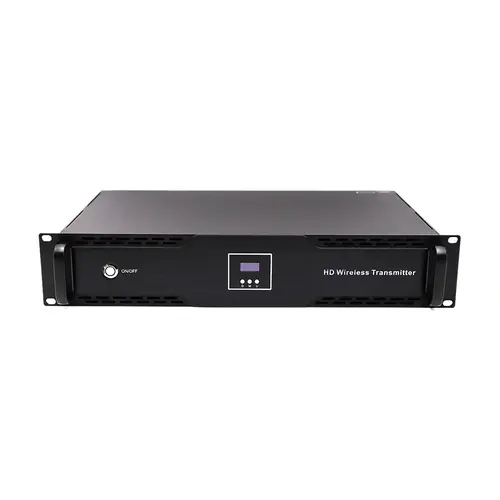
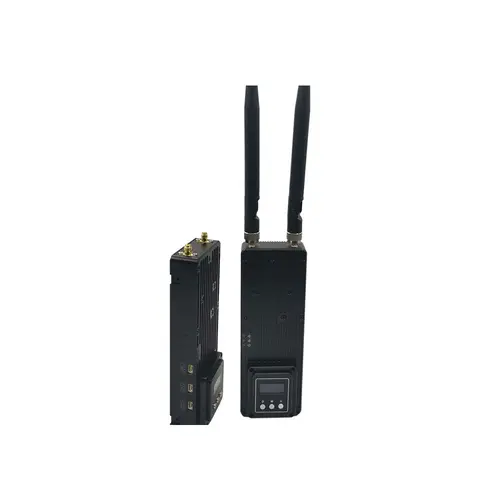
While consumer wireless transmission technologies serve their markets well, mission-critical applications — military operations, public safety, broadcast ENG, and industrial UAV control — demand capabilities beyond what Bluetooth, Wi-Fi, or even 5G can reliably deliver over long, non-line-of-sight paths. COFDM (Coded Orthogonal Frequency Division Multiplexing) technology fills this gap, providing robust wireless transmission with exceptional multipath and NLOS performance, low latency, and AES-encrypted security. Unlike Wi-Fi’s contention-based access, COFDM offers deterministic, licensed or license-exempt spectrum efficiency ideal for real-time video and data in challenging environments.
Conclusion
Each wireless transmission technology has its place: Bluetooth for personal-area connectivity, Wi-Fi for local networking, ZigBee for IoT mesh, satellite for global coverage, and 5G for wide-area mobile broadband. For defense, public safety, and broadcast professionals who need reliable long-range video and data transmission in NLOS conditions, COFDM-based wireless transmission systems remain the proven choice.