HBFDD-A NLOS Bidirectional Broadband Transceiver
HBFDD-A
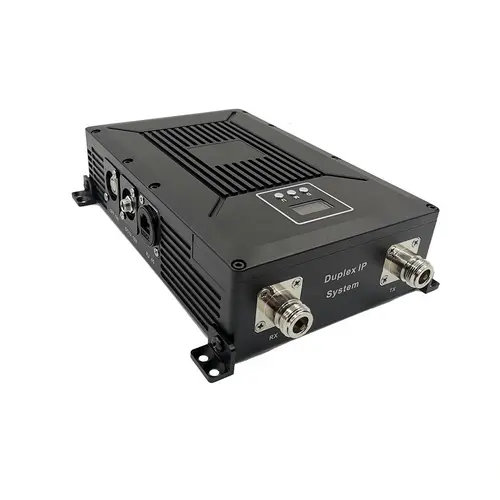
FDD frequency-division duplex NLOS broadband system with 5W output and AES256 for soldier-worn and backpack mobile data links in complex environments.
Technical Specifications
| FDD | 300–900 MHz (customizable) |
|---|---|
| 1–5W LCD adjustable | 2–25 Mbps |
| 80 ms latency | AES256 dynamic key |
| Urban NLOS 1–2 km | LOS 2–10 km |
| TCP/IP transparent | RS-232 full-duplex |
Dimensions: 200 × 130 × 52 mm · 1.5 kg
Overview
The HBFDD-A is a fixed and manpack-deployable non-line-of-sight (NLOS) bidirectional broadband transmission system built on FDD frequency-division duplex technology. Unlike TDD-based systems that share a single channel for transmit and receive, the HBFDD-A uses two symmetric frequency channels separated by guard bands, enabling full-duplex communication with greater range and more stable throughput. It operates in the 300-900 MHz band with adjustable channel bandwidth from 1 to 8 MHz and delivers data rates between 2 and 25 Mbps.
Designed for the single soldier in the field, the HBFDD-A weighs just 1.5 kg and measures 200 x 130 x 52 mm — compact enough for backpack integration or fixed installation in a command vehicle. The system includes a built-in LCD panel for on-site parameter display and adjustment, signal level strength indication, and supports both symmetric and asymmetric bandwidth modes for flexible deployment. Output power is adjustable from 1 to 5 W via the LCD interface.
Key Features
- FDD frequency-division duplex provides superior anti-interference and anti-multipath fading performance compared to TDD, with continuous spectrum in both directions and no time-slot sharing
- NLOS transmission capability overcomes building occlusion, terrain shadowing, and multipath reflection in dense urban, forested, and mountainous environments
- Adjustable 1-8 MHz channel bandwidth via onboard LCD panel, with symmetric and asymmetric frequency modes for customized link configuration
- 256-bit AES dynamic encryption secures all data, voice, and video traffic with non-standard key management
- Full-duplex RS-232 serial data alongside standard 10/100Base-T Ethernet, enabling simultaneous sensor telemetry and IP data flows
Technical Highlights
The HBFDD-A's FDD architecture delivers a key advantage in electromagnetic interference environments. Strong interference on FDD affects only the uplink or downlink separately, while a TDD system under similar conditions may cease operation entirely. The system achieves an 80 ms end-to-end latency with receiver sensitivity of -96 dBm at 8 MHz bandwidth. In NLOS urban conditions it reaches 1-2 km, extending to 2-10 km in LOS open environments. The dual N-type RF interfaces support omnidirectional antennas that require no angular alignment, enabling true plug-and-play deployment.
Applications
The HBFDD-A is deployed in public security, fire and rescue, traffic police, civil air defense, urban management, environmental monitoring, flood control, power and railway emergency response, maritime law enforcement, customs and border security, forest fire prevention, military reconnaissance, and television broadcasting. It is especially valuable in scenarios where the communication path is obstructed — between buildings in urban canyons, behind hills in mountainous terrain, or across complex industrial sites.
Why Choose This System
The HBFDD-A delivers FDD's inherent robustness against interference and multipath fading in a lightweight, soldier-portable package. Its 5 W output and 25 Mbps peak throughput provide a stable full-duplex link where TDD systems struggle, and the LCD-based no-tool configuration means it is operational within minutes of arrival on site.
Compare Models
This product belongs to the HBFDD-A family. See also:
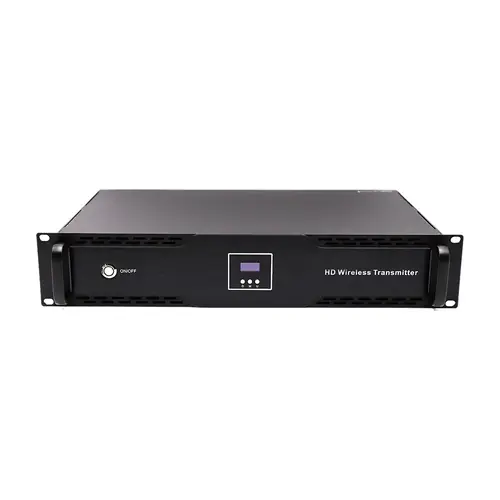
HBFDD-B High-Power Bidirectional Broadband System
High-power 40W FDD bidirectional broadband system for long-range vehicle, ship, and fixed-site links up to 40 km with AES256 dynamic encryption.
- FDD · 300–900 MHz (customizable)
- 10–40W LCD adjustable · 2–25 Mbps
- 80 ms latency · AES256 dynamic key
- NLOS 5–20 km · LOS 20–40 km
- 2U rack · AC 220V / DC 28V
- 485 × 340 × 90 mm (2U) · 4.5 kg
Related Products
HBFDD-B High-Power Bidirectional Broadband System
High-power 40W FDD bidirectional broadband system for long-range vehicle, ship, and fixed-site links up to 40 km with AES256 dynamic encryption.
- FDD · 300–900 MHz (customizable)
- 10–40W LCD adjustable · 2–25 Mbps
- 80 ms latency · AES256 dynamic key
- NLOS 5–20 km · LOS 20–40 km
- 2U rack · AC 220V / DC 28V
- 485 × 340 × 90 mm (2U) · 4.5 kg
Interested in This Product?
Contact us for pricing, custom configurations, and technical support for the HBFDD-A NLOS Bidirectional Broadband Transceiver.
Get a Quote